Your Fingers Are Lying to Your Brain: The Wild Neuroscience Behind Every Typo You Make
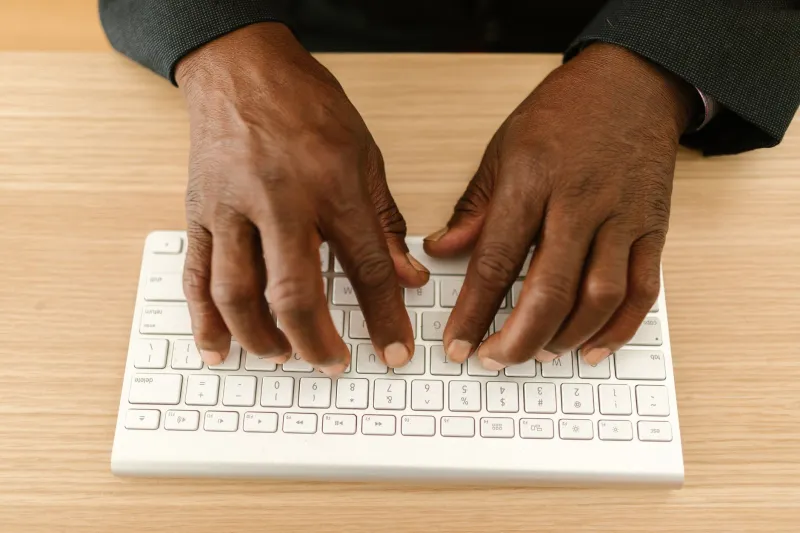
You've done it a hundred times. You fire off a text, hit send, and then — half a second too late — you spot it. A mangled word. A missing letter. Maybe you wrote 'ducking' when you absolutely did not mean 'ducking.' Your brain knew what it wanted to say. Your fingers had other plans. So what exactly went wrong in the roughly 0.3 seconds between thought and keystroke?
Spoiler: it's not carelessness. It's neuroscience. And honestly, it's kind of fascinating.
Your Brain Is Running Two Programs at Once
Here's the thing most people don't realize: when you type, your conscious brain and your motor system are basically working on separate tracks. Your conscious mind is busy thinking about what you want to say — the meaning, the tone, whether you sound too passive-aggressive in that work email. Meanwhile, your motor cortex is handling the physical execution: which fingers to move, in what sequence, with what pressure.
Under normal conditions, these two systems sync up pretty well. But the moment you introduce speed — like when you're trying to bang out a reply before your lunch break ends — the coordination starts to break down. Your fingers, which have been trained through thousands of hours of repetition, want to move fast. Your language-processing brain, which is doing something genuinely complex every single time you form a sentence, just can't always keep pace.
Neuroscientists call this kind of error a motor slip. Your brain essentially queued up the right intention but the physical execution got scrambled. It's the same reason musicians sometimes play the right notes in the wrong order when they speed up a piece before they've truly mastered it.
The Faster You Type, the Dumber Your Fingers Get
Here's a counterintuitive truth: skilled typists actually make more proportional errors at higher speeds, not fewer. A 2013 study out of Vanderbilt University found that fast typists often can't even identify which finger hits which key when asked directly — they've internalized the skill so deeply that it lives below conscious awareness. That's impressive, but it also means errors can slip through without any mental alarm going off.
This is where sites like TypeRacer or Nitro Type — speed-typing games that have built a whole culture around competitive keyboard mashing — get genuinely interesting from a brain-science angle. These games are essentially stress-testing the gap between your motor system and your language brain in real time. When you're racing another player and the clock is ticking, your motor system kicks into overdrive while your error-checking system gets deprioritized. The result? A beautiful mess of almost-words that your fingers were absolutely convinced were correct.
The games are fun precisely because they exploit this gap. The pressure is artificial, but the cognitive breakdown it triggers is completely real.
Why Autocorrect Exists (And Why It Sometimes Makes Things Worse)
Autocorrect was invented to patch exactly this disconnect. When your fingers type 'recieve' instead of 'receive,' autocorrect swoops in like a hall monitor and fixes it before you even notice. At its best, it's seamless. At its worst — well, there's a reason 'autocorrect fail' has its own corner of the internet.
The problem is that autocorrect is essentially guessing what your brain intended based on what your fingers produced. When those two things are far apart, the software has to make a judgment call, and it doesn't always make the right one. It's working with probabilities, not telepathy. So when you type 'I'm on my way, ducking traffic,' the algorithm sees a real word in a plausible context and goes with it — even if the result is something your grandmother will definitely screenshot.
What autocorrect can't do is account for the semantic layer — the actual meaning you were building toward. That part lives entirely in your head, and no algorithm has cracked it perfectly yet.
Pressure Makes Typos Worse. Here's Why.
Ever notice that you make way more mistakes when you're stressed, rushed, or emotionally worked up? That's not your imagination. When your brain is under pressure, cognitive resources get redistributed. Your prefrontal cortex — the part responsible for careful, deliberate thinking — gets partially sidelined in favor of faster, more reactive systems. Error monitoring, which is a real neurological function that usually catches mistakes before they happen, gets deprioritized.
In plain terms: stress literally makes your proofreading worse. The angrier or more anxious you are, the more your fingers are going to go rogue. That furious text you typed at 11 PM? Your brain was running on fumes and your fingers were basically unsupervised.
This is also why typing out something emotionally charged — a difficult conversation, a complaint email, an apology — tends to produce more errors than typing something neutral. Your cognitive load is higher, so the gap between intention and execution widens.
Slowing Down Is Actually a Superpower
Here's the part nobody wants to hear: deliberately slowing down your typing can make you a significantly better writer. Not just more accurate — actually better at constructing sentences and ideas.
When you type slowly, your working memory has more time to hold multiple parts of a sentence simultaneously. You can feel where a sentence is going before you commit to it. You catch yourself mid-thought and redirect. Essentially, the language-processing side of your brain gets to stay in the driver's seat instead of scrambling to keep up with your fingers.
Some writers have taken this to an extreme — there's a whole community of people who swear by mechanical typewriters, not for nostalgia, but because the physical resistance of the keys forces them to think before they type. Same idea: friction as a feature, not a bug.
You don't have to go full typewriter. But the next time you're drafting something important, try consciously dropping your speed by 20 percent. You might be surprised how much cleaner your first draft comes out.
The Takeaway (Typed Slowly, for Accuracy)
Every typo you've ever made is basically evidence that your brain is doing something incredibly complex — and doing it fast. The disconnect between thinking and typing isn't a flaw in your character. It's a structural feature of how human cognition works under speed and pressure.
Your fingers aren't dumb. Your brain isn't slow. They're just running on different clocks. And until someone figures out how to sync them perfectly, the rest of us will keep typing 'teh' and hoping autocorrect is paying attention.
Now go play a round of TypeRacer and watch the whole thing fall apart in real time. Science is fun.